
 EN
EN



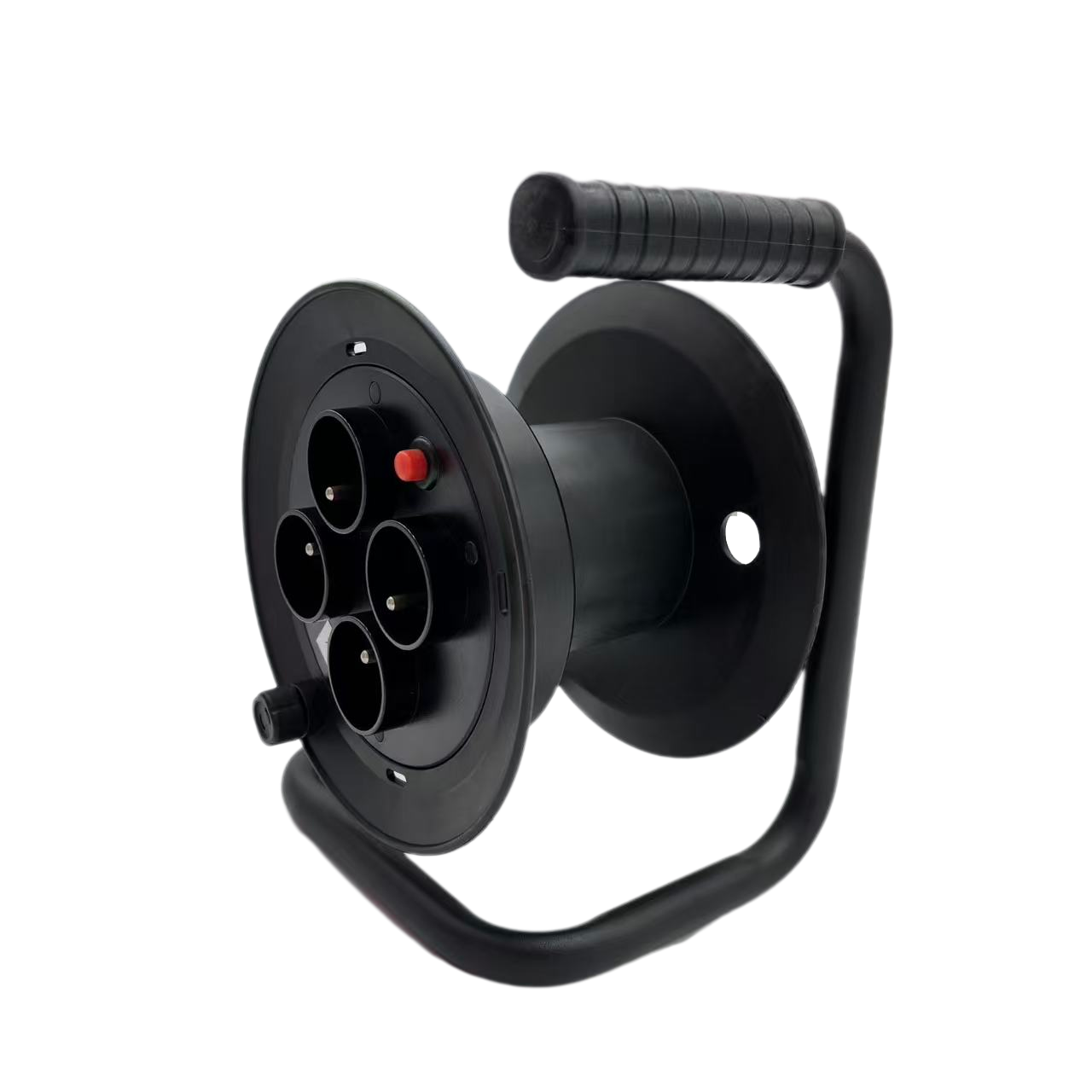
Core Functionality of Industrial Cable Reels
Industrial cable reels deliver a dual-purpose solution: robust mechanical cable management paired with uninterrupted electrical supply. By keeping heavy cables neatly wound and instantly deployable, they prevent tangling, physical damage, and costly production downtime—where reliability is non-negotiable.
Mechanical and Electrical Integration in Heavy-Duty Cable Reel Systems
Heavy-duty cable reels integrate a precision-engineered spool, rugged housing, and a rotary electrical interface—typically a slip-ring assembly—that maintains live power, control signals, or data transmission while the cable winds or unwinds. The mechanical design must endure constant tension, high retraction forces, and harsh conditions including dust, moisture, and vibration. Electrically, spring-loaded contacts or brush-style slip rings ensure seamless conduction without twisting or stressing conductors. This architecture eliminates manual plug-in/out cycles, enabling mobile equipment—such as cranes, automated conveyors, or robotic arms—to draw high current continuously. The result is a dynamically balanced system that minimizes energy loss, preserves cable insulation integrity, and maintains safe operating clearances—even under demanding duty cycles.
Motor-Driven vs. Spring-Return Cable Reels for High-Current Applications
High-current applications demand retraction mechanisms matched to cable weight, length, and usage frequency. Spring-return reels use a pre-tensioned coil spring for automatic rewind—ideal for shorter runs (up to ~30 m) and intermittent use. Their compact, low-maintenance design offers cost efficiency but suffers diminishing retraction force with extension and requires precise spring sizing to avoid hazardous snap-back. Motor-driven reels, by contrast, employ gear-reduced electric motors to deliver consistent, controllable retraction regardless of extension length. They excel with heavy, long cables—such as 4/0 AWG or larger—carrying hundreds of amps in ship-to-shore power, mining shovels, or large-scale automated storage systems. Integrated PLC controls enable soft-start/stop, torque limiting, and remote monitoring—enhancing safety and extending cable life. As global demand for industrial cable reels reached $1.87 billion in 2023—and automation accelerates—motor-driven systems are increasingly preferred where uptime, precision, and high-power throughput are mission-critical.
Safety Compliance and Risk Mitigation with Cable Reels
Eliminating Trip Hazards and Ensuring OSHA Compliance Through Dynamic Cable Management
Slips, trips, and falls account for 15% of all workplace fatalities (OSHA, 2023), with exposed cables on factory floors and job sites among the top contributing hazards. Industrial cable reels mitigate this risk through dynamic cable management: spring-return and motor-driven models retract unused cable instantly into a protected housing when operation pauses—leaving no trailing loops to snag feet or equipment. This active housekeeping aligns directly with OSHA’s walking-working surfaces standard (29 CFR 1910.22), which mandates clear, uncluttered aisles. Beyond compliance, eliminating manual coiling reduces cable abrasion, kinking, and insulation damage—lowering long-term maintenance costs and sharply reducing cable-related trip incidents.
Electrical Safety: Grounding, Overcurrent Protection, and Hot-Swap Protocols
Electrical safety begins with a continuous, low-impedance ground path—every industrial cable reel must bond the equipment grounding conductor from inlet to outlet to prevent shock during insulation failure. Overcurrent protection is equally essential: coiled cables under high load generate rapid heat buildup, risking insulation degradation and arc faults. EN 61316-compliant reels incorporate thermal cut-outs that de-energize the circuit before critical temperatures are reached—a proven safeguard against electrocution and fire (HSE, 2014). Residual current devices (RCDs) add a second layer of protection by detecting earth leakage. Hot-swap protocols further protect personnel: power must always be disconnected at the source before accessing junction boxes or collector-ring housings, and rated voltage/amperage limits must never be exceeded. Together, grounding, overcurrent protection, and disciplined disconnection transform cable reels from potential hazards into code-compliant, high-integrity power delivery tools.
Cable Reels in Critical Power-Intensive Industries
Field-Validated Downtime Reduction in Mining, Oil & Gas, and Energy (Up to 37% per Maintenance Cycle)
In mining, oil & gas, and power generation, unscheduled downtime incurs extraordinary costs—a single mining dragline outage can exceed $100,000/hour; offshore platform BOP failures trigger regulatory penalties plus $1.2 million/day in lost revenue (API, 2023). Industrial cable reels directly reduce these risks by delivering reliable, organized power to mobile equipment. A multi-year field study across six copper mines documented a 37% reduction in downtime per maintenance cycle after replacing loose-cable arrangements with armored cable reels (Mining Equipment Reliability Study, 2019). Gains stem from physical protection—reels shield cables from crush, abrasion, and torsional stress in underground galleries—and operational agility: quick-change designs cut mean time to repair to under 20 minutes, enabling hot-swap servicing without halting production. In offshore drilling, spring-return reels maintain precise tension on BOP power lines—eliminating prior cable-snag events that caused 12-hour derrick shutdowns. At thermal power plants, motor-driven reels on fuel-handling gantries ensure uninterrupted power to stacker/reclaimers, cutting conveyor outages by 15% annually. These field-validated improvements yield payback periods under two months—making cable reels a cornerstone of critical infrastructure resilience.
Selecting the Right Cable Reel: Standards, Materials, and Environmental Readiness
Hazardous Location Certification: ATEX, IECEx, and NEC Compliance for Industrial Cable Reels
Deploying cable reels in environments with flammable gases, combustible dust, or fibers demands strict adherence to hazardous location standards. The ATEX 2014/34/EU directive (Europe), IECEx certification (global), and NEC Articles 500–505 (North America) define area classifications and required protection methods. An intrinsically safe or explosion-proof reel rated for Zone 1 or Class I Division 2 must feature sealed enclosures, static-dissipative materials, and temperature-limited components to prevent ignition. According to NFPA data, equipment non-compliance contributed to 18% of industrial fires in classified locations in 2023. Specifying a properly marked unit—e.g., Ex d IIB T4—ensures both regulatory compliance and operational continuity. Beyond explosion protection, cable jackets must resist chemical exposure and UV degradation for outdoor use, and enclosures must meet IP66 or higher for dust-tight, water-resistant performance. Non-compliant equipment exposes facilities to OSHA fines exceeding $100,000 per violation (2024). Valid third-party test reports and a Declaration of Conformity confirm rigorous adherence to safety standards—protecting personnel, assets, and operational uptime.
FAQ
What are the main benefits of industrial cable reels?
Industrial cable reels provide robust cable management and uninterrupted power supply, preventing cable tangling, physical damage, and production downtime while ensuring a safer workplace environment.
What is the difference between spring-return and motor-driven cable reels?
Spring-return reels use a pre-tensioned coil spring for retraction, suitable for shorter cables and lower loads. Motor-driven reels use electric motors for consistent retraction and are ideal for heavy-duty, high-current applications with longer cables.
How do cable reels improve workplace safety?
Cable reels prevent trip hazards by retracting unused cables into a protected housing, aligning with OSHA compliance, and reducing workplace injuries associated with slips and trips.
What industries benefit the most from industrial cable reels?
Mining, oil & gas, and power generation industries benefit significantly as cable reels enhance uptime, reduce downtime by up to 37%, and provide reliable power distribution for critical applications.
What certifications are essential for cable reels in hazardous locations?
Certifications such as ATEX, IECEx, and NEC are crucial for cable reels used in hazardous locations to ensure safety and compliance with regulatory standards.